1121 Steam vs Golden Sella vs Creamy Sella Basmati Rice: Complete Importer's Guide
Direct Answer — Executive Summary
1121 Basmati is India’s most traded premium Basmati variety — an extra-long-grain rice with 8.30–8.40 mm raw length that elongates to ~20–22 mm on cooking. The three grades importers compare are distinguished by processing, not genetics: 1121 Steam (lightly steam-treated, not fully parboiled) gives brilliant-white, fluffy grains with strongest Basmati aroma; 1121 Creamy Sella / White Sella (lightly parboiled) gives off-white/cream firm grains with strong separation for catering and repacking; 1121 Golden Sella (fully parboiled) gives amber-golden, firmest grains with highest holding strength and 24-month warehouse stability in GCC heat. All three share the same 1121 genetics (Punjab/Haryana origin). Choose Steam for premium retail and HoReCa aroma, Creamy Sella for bulk catering and repackers needing white appearance with firmness, and Golden Sella for GCC/African banquet and long storage.
Key Takeaways
- Same paddy, different process: Steam = light steam only; Creamy Sella = light parboil (soak + steam + dry); Golden Sella = full hot-water parboil + steam curing — colour, firmness and shelf life follow processing intensity.
- Grain length is identical by genetics: All three are 8.30–8.40 mm raw (cooked 20–22 mm, 2.2–2.4× elongation) — buy on processing/cooking behaviour, not on length alone.
- Cooking performance splits by segment: Steam = softest, most aromatic, fastest cooking (12–15 min); Creamy = medium-firm with good separation; Golden = firmest, most breakage-resistant, longest holding for biryani/buffets.
- Gulf preference is material: Saudi/UAE retail and foodservice strongly favour Golden Sella for warehouse stability up to 24 months at >40 °C; Steam performs best within 18–24 months.
- Spec discipline prevents disputes: Lock 8.30 mm+ length, ≤2% broken, ≤12.5% moisture, ≤1% damaged/discoloured, 95%+ purity (1121 admixture) and ageing 18–24 mo on your proforma — not just “1121 Basmati.”
Table of Contents
- What Is 1121 Basmati Rice? Why GCC, UK and Africa Prefer It
- How Each Grade Is Made — Milling Process Explained
- 1121 Steam Basmati Rice — Best For Premium Retail & HoReCa
- 1121 White Sella / Creamy Sella — Best For Bulk Catering & Repacking
- 1121 Golden Sella Basmati Rice — Best For Middle East & Africa Banquets
- Specification Comparison Table — All 4 Grades
- Which 1121 Grade Should You Import? Buyer Matrix
- Pricing, MOQ & Container Loading — FOB Mundra/Nhava Sheva
- How JQExports Ensures Grade Consistency
- Documentation & Import Considerations by Market
- Procurement Checklist Before You Order
- FAQs
- Request FOB/CIF Pricing
- Sources
What Is 1121 Basmati Rice? Why 1121 Commands a Premium
1121 Basmati (also filed as Pusa 1121) is a relatively recent cultivar that has become the world’s most traded Basmati. Developed from traditional Basmati genetics for extra-long slender grains, it delivers 8.30–8.40 mm average grain length uncooked — among the longest of any commercially cultivated rice — with cooked elongation to ~20–22 mm (2.2–2.4×) while remaining separate and non-sticky [Medhya Enterprises spec: 8.35 mm min; AHK Rice: 8.20–8.40 mm; JQExports product page: 8.30 mm+; SHRI Lalmahal: 8.35 mm min].
Three agronomic traits explain GCC, UK and African buyer preference:
1. Elongation and plate yield. In documented quality studies, 1121 cooks to 21–22 mm [AHK Rice 2026]. For biryani houses and hotel buffets, that elongation means fewer kilograms per served portion versus shorter IR64 or Sona Masoori — a direct plate-yield advantage.
2. Ageing potential. 1121 lots are conventionally aged 12–24 months (JQExports lots minimum 18 months) to harden starch, deepen aroma release and reduce breakage during milling and cooking [Medhya: 12–24 mo aged; JQExports: 18–24 mo]. Older lots command higher prices but hold shape longer on a service pass.
3. Origin discipline. Authentic 1121 is grown under India’s Geographical Indication belt — Punjab, Haryana, parts of western UP, Rajasthan and Uttarakhand. APEDA registration is mandatory for Basmati export from India; variety purity is policed under India’s Basmati Code of Practice (typically >7% non-Basmati considered adulterated if labelled “Basmati”) [Medhya; Trade guidance].
Buyer note: Authenticity is not proven by grain length alone — shorter varieties (1509, Sugandha) can be polished to look long. Request the supplier’s varietal purity statement and APEDA RCMC, and where disputed, request a varietal admixture test (DNA marker) from a lab.
How Each Grade Is Made — Milling Process Explained
All three grades start as 1121 paddy (the same genetics). The grade name describes the hydrothermal treatment applied in the husk before milling:
| Step | 1121 Steam | 1121 Creamy / White Sella | 1121 Golden Sella |
|---|---|---|---|
| 1. Soak | No soaking — paddy goes straight to light steaming | Light soak in warm water | Full hot-water soak (longest) |
| 2. Heat | Light steam (short duration, lower pressure) | Steam under moderate pressure | Steam under pressure (full parboil) |
| 3. Dry | Tempered, then milled | Dried, then milled | Dried slowly, then milled |
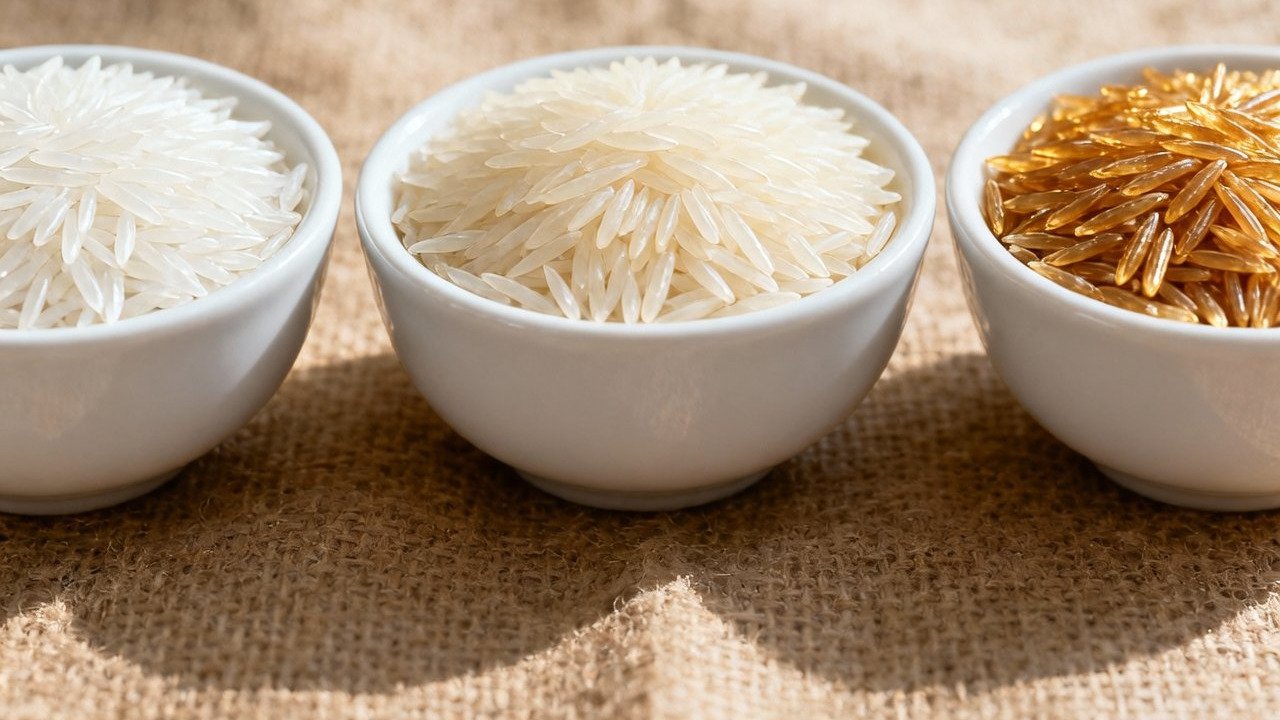
| 4. Result in husk | Starch partly gelatinized — grain stays white | Starch more gelatinized — grain turns creamy-white, stronger | Starch fully gelatinized — grain turns amber-golden, hardest |
| 5. Milled colour | Brilliant white to off-white | Creamy-white / off-white | Amber-golden (natural, no dye) |
| 6. Aroma retention | Highest Basmati aroma | Medium — milder than Steam | Mildest — parboiling reduces volatile aromatics |
| 7. Firmness after cooking | Fluffy, soft-firm | Medium-firm, well separated | Firmest, most separate, most breakage-resistant |
In short: Steam = aroma + whiteness; Creamy Sella = appearance + separation balance; Golden Sella = firmness + storage. This processing ladder is why Saudi HORECA and UAE retail chains routinely specify Golden Sella: the full parboil locks bran vitamins into the endosperm, hardens the kernel against breakage during large-batch dum cooking and buffet holding, and extends warehouse stability in high heat [AHK Rice: Golden Sella lasts 24 mo vs Steam 18–24 mo; Qatar HORECA guide: Golden holds >40 °C; Nitra Foods: Sella most forgiving in large batches].
1121 Steam Basmati Rice — Best For Premium Retail & HoReCa
Raw colour: Bright white to creamy-white — closest to traditional raw Basmati. Cooked behaviour: Very fluffy, fully separate grains, soft bite with Basmati fragrance most intact. Cooks fastest: 12–15 min (plus 30 min soak) at 1 : 1.5 water ratio [Nitra Foods; AHK Sella vs Steam].
Where buyers specify it:
- Premium retail pouches (1 kg, 5 kg BOPP) for GCC supermarkets, UK Asian grocery, US ethnic retail — where white plate appearance and aroma sell.
- Hotel pulao, jeera rice, korma rice and à-la-carte biryani where made-to-order and served within 30 minutes.
- Foodservice where aroma matters more than multi-hour holding.
Watch-outs: Steam is less forgiving if over-soaked (>45 min) or over-stirred — broken % rises. For holding >2 hours (banquet chafing dishes), Golden Sella outperforms Steam. For Steam, control water (1 : 1.5) + soak 30 min only + rest 10 min off-heat — do not boil continuously without draining.
Typical commercial slot: 1121 Steam Basmati — FOB Mundra/JNPT — quoted as 2% broken (5% grade available at lower price) — see Pricing section.
1121 White Sella / Creamy Sella Basmati Rice — Best For Bulk Catering & Repacking
White Sella and Creamy Sella are the same light parboil family — terminology varies by mill: “White Sella” (also called “Creamy Sella”) is lightly parboiled 1121 that mills creamy-white, not golden. Some exporters treat “Creamy” as a slightly whiter cut than “White Sella,” but for procurement purposes they are near-identical: light soak + steam, then milled.
Raw colour: Creamy-white to off-white — whiter than Golden, darker than Steam. Cooked behaviour: Medium-firm, distinct separate grains, higher resistance to breakage than Steam. Soak 30–60 min; water 2.0 cups per cup soaked rice; 12–15 min boil-drain [Nitra guide].
Where buyers specify it:
- Bulk catering (20–200 kg per service) — biryani where layers are built, dum held, and plated hours apart.
- Wholesale repackers who buy in 25 kg PP and repack to 5 kg/10 kg under private label — Creamy Sella repacks white, holds shape, and costs 8–12% less than Golden Sella in the same week (directional — verify on quote date).
- Ethnic retail in UK/US where customers expect non-sticky basmati but not the deep golden colour.
Why it is often the quiet value choice: Creamy Sella delivers ~90% of Golden Sella’s firmness while retaining a whiter plate and slightly stronger aroma — at a lower price than Golden in most crop months.
1121 Golden Sella Basmati Rice — Best For Middle East & Africa Banquets
Raw colour: Bright amber-golden — natural colour from parboiling pigments migrating from husk into endosperm (no dye — SASO Saudi compliant, Gulf & Africa export). Cooked colour: Creamy-white to bright white — golden colour fades on cooking.
Cooked behaviour: Firmest, most separate grains of all 1121 grades — survives par-boil → layer → dum → 2–4 hour buffet hold → reheat with minimal breakage. Cooking: soak 30–60 min, water 2.0–2.25 cups per cup soaked, 12–15 min boil-drain, then dum/hold [Nitra; MKY KSA blog]. Yield: 95%+ cooking yield (highest of 1121 grades) with up to 22 mm cooked length [Lababdar Foods spec].
Where buyers specify it — and why Gulf buyers insist on it:
- Saudi Arabia / UAE / Qatar / Kuwait foodservice: Golden Sella’s full parboil gives 24-month warehouse stability at >40 °C versus Steam at 12–18 mo [AHK Saudi guide; Qatar HORECA guide]. In Saudi warehouses operating at high summer temperatures, Golden maintains grain stability while Steam requires faster turnover.
- Banquet/catering for weddings, Hajj/Umrah catering, large biryani houses: Holds shape on serving trays for hours without clumping or breaking — “almost unbreakable grain” is the Gulf trade descriptor [Lababdar].
- Africa (Kenya, South Africa, West Africa): Long storage, firm texture for oil-rich stews — same parboil logic as IR64 Parboiled, but at Basmati premium tier.
Trade-off: Mildest Basmati aroma — parboiling reduces volatile aromatics versus Steam. For aroma-sensitive menus, blend 10–20% Steam into Golden (if your standard allows) — but declare varietal composition and test cooking time: Steam cooks faster than Golden in the same pot.
Specification Comparison Table — 1121 Grades + 1509 Reference
Indicative commercial ranges. Lock your lot-specific limits on the proforma — moisture, broken and purity govern disputes. JQExports live lot specs shown where verified.
| Parameter | 1121 Steam Basmati | 1121 Creamy / White Sella | 1121 Golden Sella | 1509 Steam (cost-effective alternative) |
|---|---|---|---|---|
| Average raw grain length | 8.30–8.40 mm (min 8.30 mm) | 8.30–8.40 mm (min 8.30 mm) | 8.30–8.40 mm (min 8.30 mm) — up to 8.4 mm | ~7.80–8.00 mm (shorter — price driver) |
| Cooked length / elongation | ~20–21 mm; 2.2–2.4× | ~20–22 mm; 2.2–2.4× | ~22 mm; 95%+ yield; 2.3–2.5× | ~18–19 mm; lower elongation |
| Colour (raw) | Brilliant white/creamy | Creamy-white / off-white | Amber-golden | White/creamy (Steam) or golden (Sella) |
| Colour (cooked) | Brilliant white | Bright white | Bright white (golden fades) | White |
| Aroma | Strongest (most volatile aromatics retained) | Medium | Mildest (parboil reduces volatiles) | Milder than 1121; cost advantage offsets |
| Texture (cooked) | Fluffy, soft-firm, delicate | Medium-firm, well separated | Firmest, most separate, most breakage-resistant | Fluffy, slightly less elongation |
| Processing | Light steam only (no full soak) | Light parboil (soak + steam) | Full parboil (hot-water soak + steam curing) | Same ladder as 1121 (Steam/Sella) |
| Moisture | Max 12.5% (JQExports lot: Max 12.5%) | Max 12–13% | Max 13% | Max 12.5% |
| Broken | Max 2% (5% grade available) | Max 2% | Max 2% (some specs <1%) | Max 2% |
| Paddy / foreign matter | Nil / ≤0.1% paddy | Nil | Nil | Nil |
| Damaged/discoloured | Max 1% (chalky <5%) | Max 1% | Max 1% (Golden Kett 20–22 vs Steam 32–34) | Max 1% |
| Purity (1121) | Min 95% pure 1121 (admixture of other Basmati ≤5%) | Min 95% | Min 95% (field admixture ≤8% on some specs — stricter is better) | 95% pure 1509 |
| Ageing | 18–24 mo (JQExports 18+ mo) | 12–24 mo | 12–24 mo | 12–18 mo typical |
| Shelf life (cool/dry) | 18–24 mo | 18–24 mo | 24 mo (holds best in heat) | 18–24 mo |
| Cooking time / water | 12–15 min; 1 : 1.5 | 12–15 min; 1 : 2 | 12–15 min; 1 : 2–2.25; soak 30–60 min | Similar to 1121 Steam |
How to read Kett: Golden’s lower Kett value (20–22) reflects amber colour vs Creamy/White (29–31) and Steam (32–34) — lower Kett = deeper golden [Shri Lal Mahal spec]. Not all buyers request Kett; ask if your QC uses it.
Market note on price: Export FOB India for 1121 typically bands Steam $940–$1,100/MT, White Sella $800–$1,000, Golden Sella $900–$1,000 (directional per SEFPL 2025-26 guide — verify on quote date; spread moves with paddy arrivals and Gulf demand). Verify with lot-specific FOB Mundra/JNPT.
Which 1121 Grade Should You Import? Buyer Matrix
| Buyer channel | Recommended 1121 grade | Packing sweet spot | Why |
|---|---|---|---|
| Premium GCC retail (supermarkets, private label BOPP bags) | Steam (or Steam for aroma) + Golden Sella as second SKU | 1 kg / 2 kg / 5 kg BOPP + 10 kg non-woven; bilingual AR/EN label | Steam sells on whiteness+aroma; Golden covers banquet-size 10 kg for value |
| Saudi/Gulf wholesale repackers | Golden Sella (primary) + Creamy Sella (value) | 25 kg PP → destination repack to 5/10 kg | Golden holds 24 mo in heat; Creamy is whiter, cheaper — two-tier portfolio |
| Qatar/Kuwait HORECA distributors | Golden Sella (primary) | 10 kg / 20 kg PP; catering bags | Firmness + buffet hold |
| UK Asian grocery / ethnic supermarkets | Steam (aroma) + Golden Sella (biryani) | 5 kg / 10 kg BOPP; UK BTOM-compliant label | UK consumers split: daily use = Steam; party biryani = Golden |
| US ethnic retail / foodservice | Steam (white) or 1509 Steam (cost-effective) | 10 lb / 20 lb retail (US); 20 kg catering | Steam’s aroma wins in US market; 1509 lowers cost for volume |
| Catering companies (100+ kg per event) | Golden Sella, backup Creamy Sella | 25 kg PP bulk | Breakage resistance + long holding — Sella firmness is decisive |
| Price-sensitive Africa/Middle East catering | Consider 1509 Sella or Sugandha Golden Sella as alternative | 25/50 kg PP | 25–35% cost saving vs 1121 with 7.1–8.0 mm length — ask for elongation data |
Decision rule: If your customer asks “Will it stay separate after 3 hours on a buffet?” → Golden Sella. If they ask “Will it smell like Basmati when I open the bag?” → Steam. If they ask “Best value for catering repack?” → Creamy Sella.
Pricing, MOQ & Container Loading — FOB Mundra / Nhava Sheva
MOQ: 1×20' FCL — standard for all 1121 grades. LCL and air samples available for trial (100–500 kg). Private label retail pack MOQ depends on printed bag cylinder/plate — ask for BOPP MOQ sheet.
Packing (all grades): 5/10/20/25/50 kg PP woven + jute + 1 MT jumbo + retail BOPP pouches / non-woven bags / pouch-with-liner; linen colour and AR/EN artwork per private label request [JQExports product page: 5/10/20/25/50 kg PP & jute + jumbo + retail pouches].
Container loading — 1121 (verified):
| Container | 1121 Basmati (25 kg PP bags) | Note |
|---|---|---|
| 20' FCL | 24.5 MT (JQExports) — industry range 24–25 MT | Most common for Basmati — weight-limited before cube-limited; palletised = 21–22 MT (lose ~2.5 MT to pallets) |
| 40' HQ FCL | 26 MT (JQExports) — industry range 26–28 MT | Only where destuffing supports 40' HC; many buyers prefer 20' for Basmati due to grain pressure |
Incoterms & ports: JQExports loads out of Mundra, Pipavav, Kandla and Nhava Sheva (JNPT) on FOB, CFR, CIF Incoterms 2020, with 7–14 business days dispatch from contract/LC confirmation [verified from live product pages — ports, Incoterms and lead-time language consistent across product specs]. Transit: Mundra→Jebel Ali ~4 days, →Jeddah/Dammam ~8–10 days, →Rotterdam ~24–32 days, →New York ~30–38 days (directional — confirm sailing at booking; Red Sea routing affects 2026).
Payment: Sight LC at sight / TT (30/70 or 40/60 variants) per buyer risk tier — as listed live.
How JQExports Ensures Grade Consistency
Live product verified: JQExports supplies 1121 Steam Basmati (Steam) as a stocked grade — extra-long grain, aged 18+ months, 2% broken (5% grade available), extra-long 8.30 mm+, with Sortex cleaning, NABL lot-level COA, and FOB Mundra/JNPT + CFR/CIF dispatch in 7–14 business days [live product page https://jqexports.com/products/basmati-rice-1121-steam].
What grade consistency means operationally for 1121:
Sortex cleaning: Multi-stage cleaning — destoner → magnetic trap → gravity separator → Buhler-type optical colour sorter — removes off-colour, chalky and discoloured grains that otherwise raise Kett variance and broken %.
Lot-level COA: Every FCL ships with a lot-specific COA stating grain length (AGM calliper), broken %, moisture, foreign matter, damaged/discoloured, chalkiness and ageing — test partner disclosed on COA header. For EU/UK lots, add pesticide-residue panel on request.
Pre-shipment sample (PSS): On request, a 200–500 g PSS is air-couriered with its lot COA; the physical warehouse lot is held against your approved PSS for a defined window (commonly 5–7 days pending LC/proforma) — a company SOP, not a legal guarantee.
Third-party inspection: SGS, Bureau Veritas, Intertek or Geo-Chem at Mundra/JNPT — quantity, weight, packing, lot-traceable sampling, container stuffing supervision — coordinated on buyer nomination.
What we do not claim: Certifications, stock availability and mill throughput are per current approved business record — not invented on this page. Specifications above are per live product spec and cited market specs — your lot’s COA governs the shipment.
Internal links: Category: Rice | Product: 1121 Steam Basmati + Non-Basmati IR64 | Trust: Quality Assurance | Guides: Basmati Grades & Ageing + Import Documentation Checklist | Process: Export Process | Private Label: Private Label
Documentation & Import Considerations by Market
India export gate (all markets): APEDA RCMC, GST, Company bank details — verify supplier’s IEC on DGFT, APEDA on APEDA portal, FASSAI licence where applicable. Documents per FCL: Commercial Invoice, Packing List, Bill of Lading, Certificate of Origin, Phytosanitary Certificate, Fumigation Certificate, Health Certificate where stipulated, and lot COA [generic documentation list — confirm with CHA as not all docs apply to rice everywhere].
UAE / GCC (primary for Golden Sella): Halal documentation where required, bilingual AR/EN label, GSO-compliant net weight/marking, Jebel Ali/Dammam/Jeddah port delivery terms — see linked Dubai FIRS guide (upcoming B-04) for FIRS registration flow and municipality specifics.
UK: Post-Brexit BTOM/CHED-D/IPAFFS for certain consignments — verify via UK government IPAFFS at time of shipment; CHED-D where applicable (not for all Basmati — confirm with UK agent based on current SPS categorisation).
EU: Basmati Code of Practice — variety purity >93% if labelled Basmati; pesticide default MRL 0.01 mg/kg where no specific MRL listed — request LC-MS/MS panel for EU lots.
Importer obligation: HS code for Basmati is typically ITC-HS 10063020 (semi/wholly milled Basmati rice) — confirm eight-digit HS with your customs broker for both India export filing and destination import tariff/duty (UK Global Tariff, EU TARIC, US HTS 1006.30 etc.). HS changes require broker reconfirmation.
Procurement Checklist Before You Order
Copy-paste into your RFQ:
- [ ] Grade: Steam / Creamy Sella / Golden Sella — or mixed SKUs in one FCL with ratio
- [ ] Raw grain length: min 8.30 mm (reject <8.00 mm as blend risk)
- [ ] Broken: Max 2% (or 5% economy — state explicitly)
- [ ] Moisture: Max 12.5% (tighter 12% where buyer spec requires)
- [ ] Foreign matter: Nil — paddy ≤0.1% — damaged/discoloured ≤1%
- [ ] Purity: Min 95% pure 1121 (admixture ≤5%; stricter where you label varietal)
- [ ] Ageing: ___ months (JQExports Steam lots: 18–24 mo)
- [ ] Packing: 5/10/25/50 kg PP + jute + jumbo or retail BOPP zipper — with AR/EN artwork approval if private label
- [ ] Quantity: 20' (24.5 MT) or 40' HQ (26 MT) — palletised 21–22 MT
- [ ] Incoterm: FOB Mundra / Pipavav / Kandla / Nhava Sheva (JNPT) — or CFR/CIF ___ port
- [ ] Payment: LC at sight / TT (___%) — inspection cost allocation: ___
- [ ] Inspection: SGS / BV / Intertek / Geo-Chem — sampling + stuffing supervision included?
- [ ] Documentation: COA + phyto + COO + fumigation + health — lot-specific, not generic
- [ ] Hold window: PSS + COA held against physical lot for ___ days pending LC/proforma
Frequently Asked Questions
What is the difference between 1121 Steam and 1121 Golden Sella?
1121 Steam is lightly steam-treated only (no full soak) — mills brilliant-white, retains the strongest Basmati aroma, cooks in 12–15 min, and is best for premium retail and made-to-order HoReCa where whiteness and aroma sell. 1121 Golden Sella is fully parboiled (hot-water soak + steam curing), mills amber-golden, cooks firmest with highest breakage resistance and 24-month warehouse stability in GCC heat, and is best for banquets, large biryani and long storage. Raw grain length (8.30–8.40 mm) and genetics are identical — processing creates the difference.
Which 1121 grade is best for Saudi Arabia?
For Saudi Arabia (and wider Gulf), Golden Sella is the default for wholesale, catering and most retail private label — it holds shape through large-batch dum and 2–4 hour buffet service and maintains grain stability for up to 24 months in >40 °C warehouses, while Steam typically needs 18–24 month turnover. Many Saudi buyers stock both: Golden Sella for banquets and Steam for premium aroma-led pouches. Confirm with your Saudi importer’s channel — HORECA strongly favours Golden; premium modern trade sometimes prefers Steam.
What is the standard broken percentage in 1121 Basmati?
Export standard is Max 2% broken — this is what JQExports specifies for 1121 Steam (5% grade available at lower price). Some premium specs tighten to <1% broken at a price premium. For disputes, also specify paddy grains (Max 0.1%), damaged/discoloured (Max 1%), chalky (Max 5%) and foreign matter (Nil) — broken % alone does not define the grade. Verify on your lot’s COA with method reference.
What is the MOQ for 1121 Basmati rice export?
Standard B2B MOQ is 1×20' FCL — 24.5 MT (palletised 21–22 MT) for 1121 Basmati — as listed live on JQExports product pages. LCL and air samples (100–500 kg) are available for trial. For printed private label bags (BOPP/non-woven), MOQ is governed by packaging: bag printing cylinder/plate MOQ + rice MOQ — request the BOPP MOQ sheet for 1 kg/2 kg/5 kg/10 kg.
Request FOB/CIF Pricing in 24 Hours
Share: Grade (Steam / Creamy Sella / Golden Sella) + Broken % (2% or 5%) + Packing (25/50 kg PP + jute/jumbo/retail BOPP) + Quantity & Container (20' 24.5 MT, 40' 26 MT) + Destination port + Incoterm (FOB Mundra/JNPT, CFR, CIF) + Payment (LC/TT) + Sample/Inspection need.
→ Request quote: https://jqexports.com/request-quote
WhatsApp: +91 9054999986
Product: 1121 Steam Basmati | Non-Basmati IR64 | Quality: Quality Assurance
Sources and References
- JQExports live verification 2026-11-01: Homepage (18 categories, 25 countries), Sitemap, Product page https://jqexports.com/products/basmati-rice-1121-steam (8.30 mm+, 2% broken, Moisture Max 12.5%, Foreign Max 0.5%, Ageing 18+ mo, 20' 24.5 MT/40' 26 MT, FOB Mundra/JNPT), Blog index (8 posts), Countries — all fetched live.
- Medhya Enterprises, Long Grain 1121 Basmati Raw/White Sella/Steam/Golden Sella Bulk Exporter — Specification details: Grain Length typically 8.35 mm+, Elongation 2–2.5×, Moisture Max 12%, Chalky Max 3–5%, Purity Min 95%, 20' ~24–25 MT/40' ~26–28 MT. https://medhyaenterprises.com/1121-basmati-rice-exporter-raw-sella-steam-golden/ — Sep 14 2025,.
- AHK Rice (Abdul Hadi Keeran), 1121 Rice Grades Compared for Saudi Private Label Brands — 8.20–8.40 mm, comparison White/Steam/Golden/Creamy, elongation 21–22 mm, Gulf demand. https://ahkrice.com/rice-guide/1121-rice-grades-compared-for-saudi-private-label-brands/ — Jun 29 2026.
- AHK Rice, 1121 Steam vs Golden Sella for Qatar HORECA Guide — Processing: Steam-treated vs Full parboiling; 8.30–8.40 mm; cooked expansion 22 mm vs 24 mm; shelf life 18–24 mo vs 12 mo Qatar >40 °C. https://ahkrice.com/rice-guide/1121-steam-vs-golden-sella-for-qatar-horeca-guide/ — May 11 2026.
- SHRI Lalmahal, 1121 Golden Sella Basmati Rice Specification — 8.35 mm, Elongation 15 mm, Moisture <12.5%, Broken <1%, Purity 92% Min, Kett Golden 20–22. https://shrilalmahal.org/1121-golden-sella-basmati-rice.
- Nitra Foods Blog, Basmati vs Sella vs Steam Rice: Which to Buy — Raw/Steam/Sella at a glance: raw colour, cooked colour, texture, aroma, soak, water, time; Sella firmest, most separate. https://nitrafoods.com/blogs/guides/basmati-vs-sella-vs-steam-rice — Oct 1 2026.
- MKY KSA, What Makes Sella Rice Different From Basmati Steam Rice? — Full parboiling (soak+steam+dry) vs light steam; cooking time Sella 20–25 min vs Steam 12–15 min; colour, aroma differences. https://www.mkyksa.com/blogs/blog/what-makes-sella-rice-different-from-basmati-steam-rice — Aug 3 2026.
- Mahadev Overseas, 1121 Sella Basmati Rice — Complete Guide for Buyers — 8.35 mm raw, 20–22 mm cooked, moisture 13% max, firmness, hospitality use. https://mahadevoverseas.com/1121-sella-basmati-rice-the-complete-guide-for-buyers-importers-food-businesses/ — Apr 30 2026.
- Karnal Rice, 1121 Creamy Sella Basmati Rice — Spec: 8.35 mm+, Natural Admixture 5%, Purity 95%, Moisture 12% Max, Broken 0.5% Max. https://karnalrice.com/product/basmati-rice/1121-basmati-creamy-sella-rice/
- SEFPL (Shah Enterprises), What Does 1121 Mean in Basmati Rice? — 8.30 mm+ average length, Steam 8.35 mm/Soft & Fluffy, Golden 8.30 mm/Firm, Price bands FOB/Ton. https://sefpl.com/what-does-1121-mean-in-basmati-rice/
Compliance: HS code 10063020 for semi/wholly milled Basmati rice — confirm eight-digit ITC-HS with your CHA for export/import filing. MRLs/Halal/label rules per destination must be verified at shipment date. Specs in this article are indicative commercial ranges — your lot COA governs.
Source Export-Grade Indian Commodities Covered in This Guide
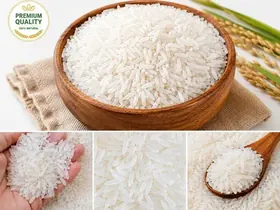 Featured
Basmati Rice 1121 (Steam)
Extra-long grain 1121 steam basmati, aged 18+ months, 2% broken — the GCC, USA and Europe…
Green Mung Beans (Moong)
Whole and polished split mung for East Asian, Middle Eastern and health-food markets —…
Non-Basmati Rice (IR64 / Swarna)
Parboiled and raw IR64 / Swarna in 5%, 10% and 25% broken — the volume workhorse for Africa…
Ready to discuss a shipment?
Our export desk responds within 24 business hours.
Request a Quote WhatsApp